







Verified on
About PhilippinesTransport.com

What PhilippinesTransport.com covers
PhilippinesTransport.com covers getting around the Philippines by ferry, bus, van, train and domestic flight: which services run, what time they leave, what they cost, and exactly where you board, from the pier printed on a ferry ticket to the terminal a night bus leaves from.
It is based in Manila, and the people behind it are Filipinos and long-term foreign residents of the Philippines.
How pages are checked
Every fact on a route or destination page comes from a source named at the bottom of that page: the Philippine government and its port and airport authorities, the transport operators, or national news. Fares and times are read from the operator, or from what is on sale for a named month, and a page is updated as soon as one of them changes. Traveller reports appear only as experience, attributed in the sentence.
Ferry routes and port positions for your own maps and apps
Developers, researchers and anyone planning island hops in a spreadsheet can take the data behind the Philippines ferry routes map:
| File | What is in it | Download |
|---|---|---|
| Ferry routes | Every inter-island crossing on the map, port to port, with coordinates, the shipping lines that sail it and the guide holding its times and fares | JSON · CSV |
| Ports, towns and airports | Each place on the map with its OpenStreetMap node, IATA code for airports; the GeoJSON adds every bus and ferry line | JSON · CSV · GeoJSON |
| The map | Vector image, tall and wide, one per site language | SVG, tall · SVG, wide |
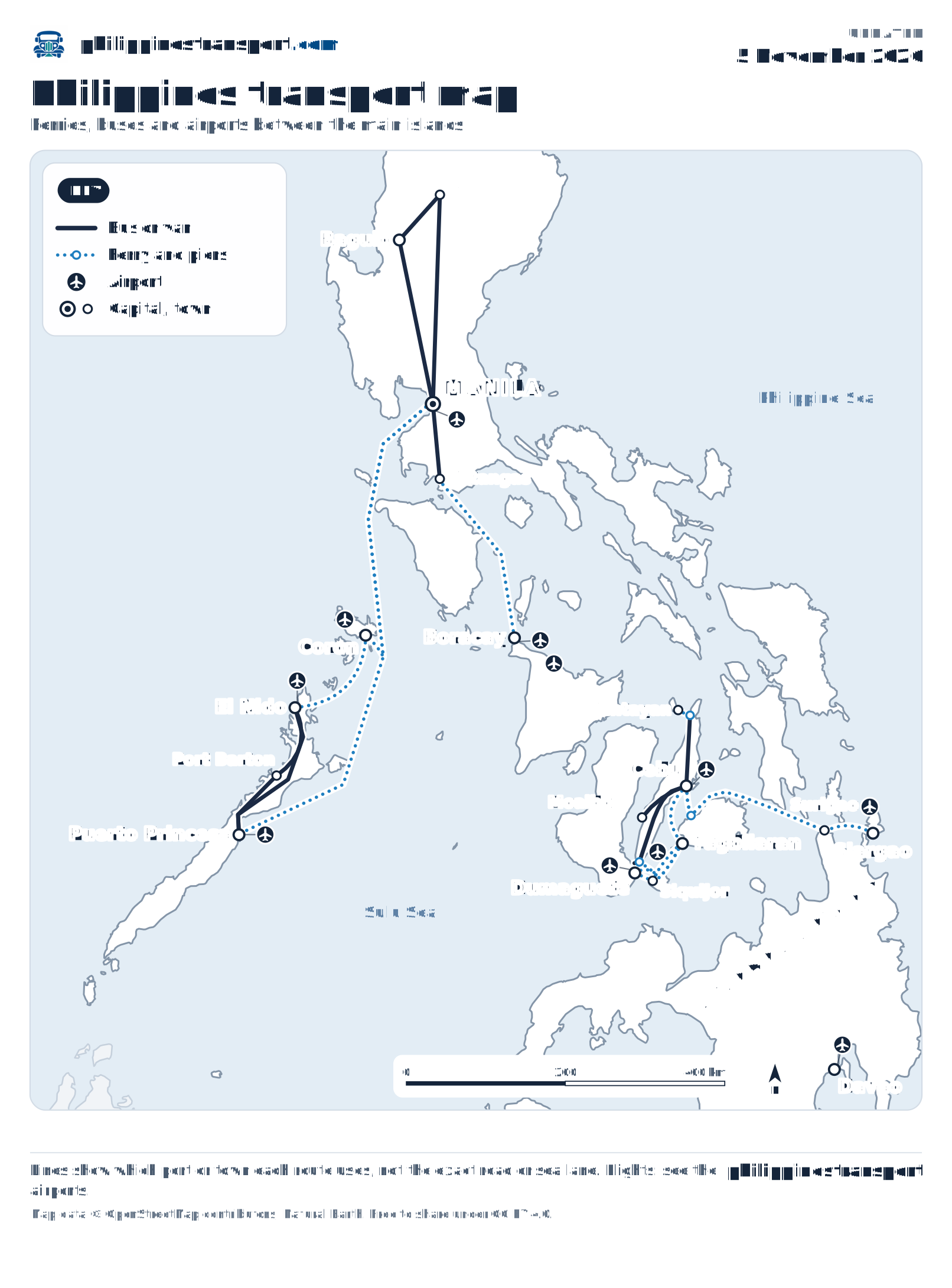
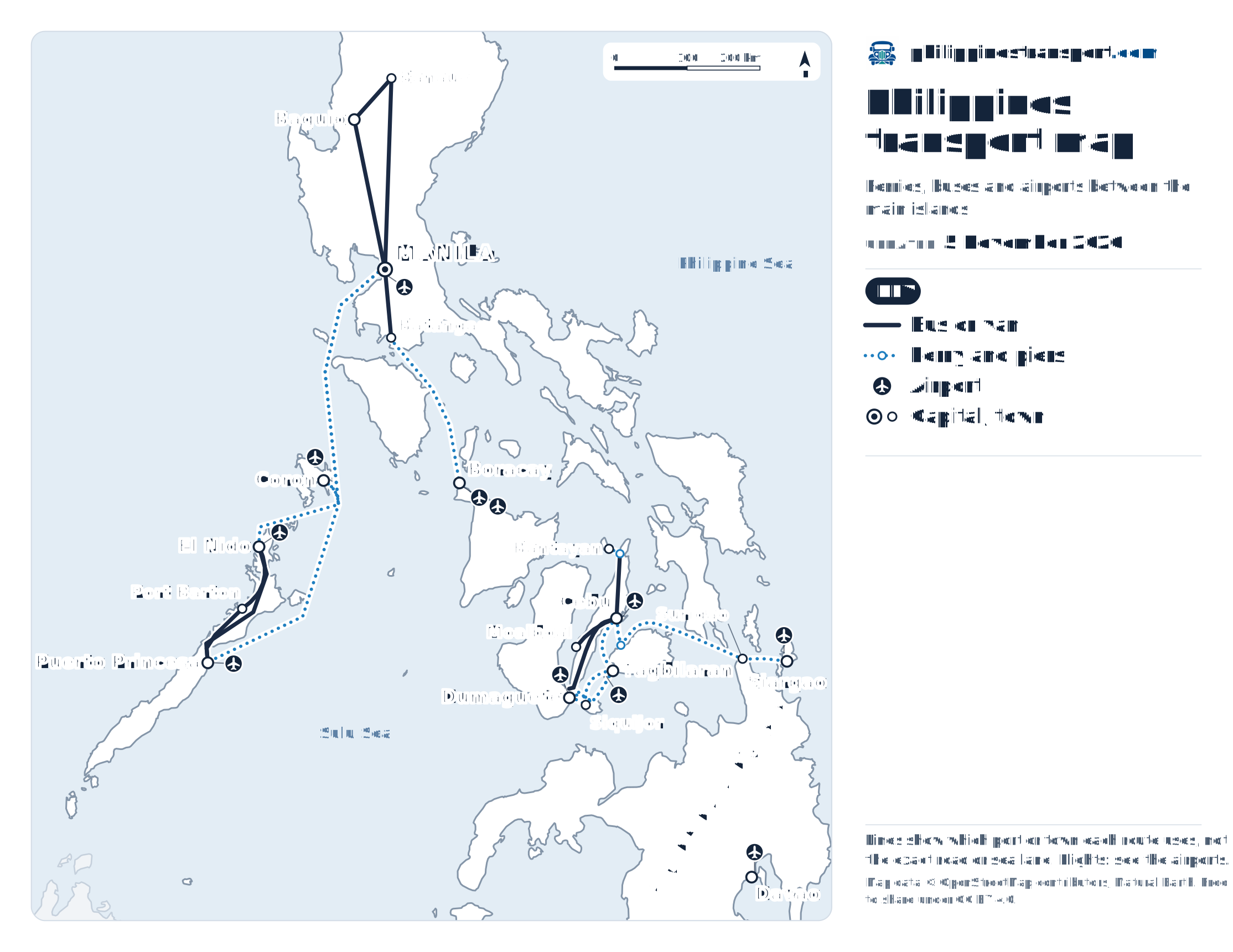
The data files carry the Open Database License, because their coordinates are OpenStreetMap's: name "© OpenStreetMap contributors" and PhilippinesTransport.com when you reuse them. The map images are CC BY 4.0. Each new version of the map regenerates the files from the same records, in English.
A permanent, citable copy sits on Zenodo under doi:10.5281/zenodo.23830271; the same files also land in the shared Southeast Asia folders on GitHub and Hugging Face, and on Kaggle.
Report a changed timetable, fare or terminal
A terminal that has moved, a fare that has gone up, a boat that no longer sails: if you have just travelled a route and a page is wrong, that is the most useful thing anyone can send. Email contact@philippinestransport.com with the page, what it says, what you found and when you travelled. A photo of a posted timetable helps.
Where to check ferry, flight and weather status
Is my ferry or flight running today? When weather stops sea travel, check the Philippine Coast Guard and PAGASA. For airports, check CAAP.
When does it leave, and how much is it? Ask the operator: its own website or ticket office has the current times and fares.
Which pier or terminal does it leave from? Ask the port authority: the Philippine Ports Authority for most of the country, or the Cebu Port Authority inside Cebu province. The terminal itself can also tell you.
Flying on to mainland Southeast Asia
The Philippines has no land border, but many trips continue with a flight to Bangkok, Hanoi, Phnom Penh or Vientiane. The same publisher runs a transport guide for each of those countries.
About PhilippinesTransport.com FAQ
Is this an official government site?
No. It has no connection to any Philippine government agency, port authority or transport operator. Where a fact comes from one of them, the page lists it under Sources.
Can you change or refund a booking?
No. Bookings made through a link on this site are handled by our booking partner or by the operator you booked with, and they are the ones who can change or refund them.
Do operators pay to be listed?
No. There is no paid placement, and no operator has a say in what a page says about it.
Can I quote a page?
A short quote with a link back is fine. Republishing a page wholesale is not. The terms page has the detail.